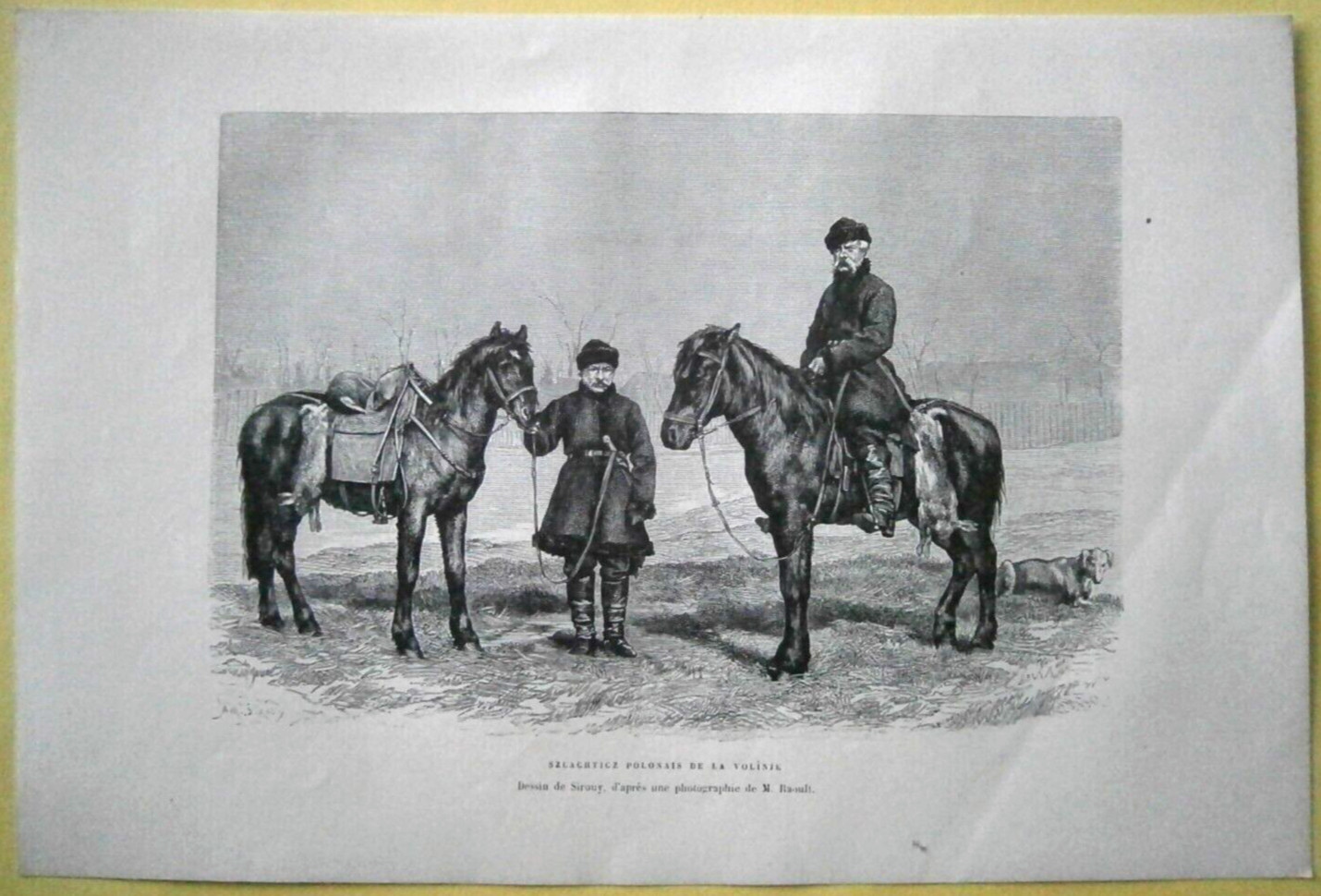
1880 Reclus print POLISH SZLACHTA IN VOLHYNIA, UKRAINE, #31
$ 13.2
Description
1880 Reclus print POLISH SZLACHTA IN VOLHYNIA, UKRAINE, #31. In 1199 Prince Roman Mstislavich of Volhynia (d. 1205) united the two territories into a powerful principality, which dominated Kiev. He successfully battled the Poles, Lithuanians, Hungarians, and Polovtsy (or Cumans) and was sought as an ally by Byzantium. Reclus0531 1880 Reclus print POLISH SZLACHTA IN VOLHYNIA, UKRAINE, #31 Nice view titled Szlachticz Polonais de la Volinie, from wood engraving with fine detail and clear impression, approx. page size is 27 x 18 cm, approx. image size is 19 x 13 cm. From La Nouvelle Géographie universelle, la terre et les hommes / The Earth and Its Inhabitants, great work of Elisee Reclus. Volhynia, also spelled VOLYNIA, Ukrainian and Russian VOLYN, Polish WOLYN, area of northwestern Ukraine that was a principality (10th-14th century) and then an autonomous component of the Grand Duchy of Lithuania and was ruled largely by its own aristocracy (after the late 14th century). The region became prominent during the 12th century, when many emigrants from the declining Kiev principality settled in Volhynia and its even more westerly neighbour Galicia. In 1199 Prince Roman Mstislavich of Volhynia (d. 1205) united the two territories into a powerful principality, which dominated Kiev. He successfully battled the Poles, Lithuanians, Hungarians, and Polovtsy (or Cumans) and was sought as an ally by Byzantium. Roman's son Daniel (reigned 1221-64) reunited Volhynia with Galicia in 1238 (the union had lapsed after Roman's death), built cities (e.g., Lviv), encouraged a flourishing east-west trade through his lands, and fostered the development of fine arts. In 1260, however, Volhynia and Galicia were devastated by a Mongol invasion and forced to recognize the Mongol khan as their overlord. In the course of the 14th century Volhynia was absorbed by the Lithuanian state and Galicia by Poland. After the Polish-Lithuanian union of 1569, Volhynia was ceded to Poland. It remained a Polish territory until the second partition of Poland (1793) transferred most of it to Russia. After World War I it was divided between Russia and Poland; and after World War II the entire region became part of the Ukrainian S.S.R.