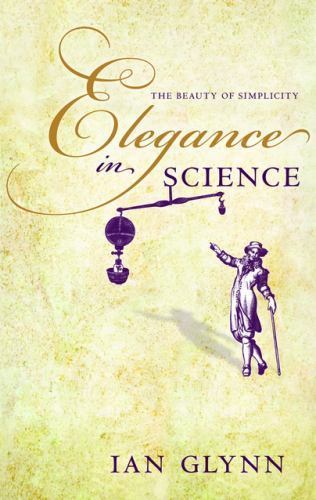
Elegance in Science The Beauty of Simplicity by Ian Glynn 2010 Hardcover

$ 3.63

Item Width: 5.8 in Intended Audience: Trade Book Title: Elégance in Science : the Beauty of Simplicity Item Height: 1.1 in Author: Ian Glynn Dewey Edition: 22 Genre: Science Topic: Philosophy & Social Aspects, General ISBN-13: 9780199578627 Number of Pages: 290 Pages Publication Year: 2010 Publisher: Oxford University Press, Incorporated gtin13: 9780199578627 LC Classification Number: Q175.32.A47 Item Weight: 17.3 Oz ISBN-10: 0199578621 Language: English brand: Oxford University Press, Incorporated Illustrator: Yes Format: Hardcover Synopsis: We usually associate a sense of elegance with art or fashion design, poetry or dance, but the idea of elegance is surprisingly important in science as well. The use of the term is most apparent in the "elegant proofs" of mathematics--which Bertrand Russell once described as "capable of a stern perfection such as only the greatest art can show"--but as Ian Glynn reveals in this fascinating new book, the idea of elegance is essential to scientists working in all fields. Glynn draws on a wide range of examples that demonstrate the elegance of science, from Pythagoras' theorem and Archimedes' proof to Kepler's Laws, the experiments that demonstrated the nature of heat, and the several extraordinary episodes that led to Watson and Crick's discovery of the structure of DNA. Scientists often share a sense of admiration and excitement on hearing of an elegant solution to a problem, an elegant theory, or an elegant experiment. For scientists, as for artists, elegance implies beauty, simplicity, clarity, and proportion; the elegant solution has a kind of stunning and unalterable rightness that inspires wonder and awe. The idea of elegance may seem strange in a discipline that prides itself on objectivity, but only if science is regarded as a dull activity of counting and measuring. It is, of course, far more than that, and Glynn shows precisely how and why elegance is a fundamental aspect of the beauty and imagination involved in scientific activity. An elegant solution may not always be a correct one, Glynn cautions, but elegance is deeply related to important philosophical issues of inference and best explanation. Written with the same clarity and elegant simplicity it describes, Elegance in Science explores an often overlooked but profoundly important aspect of scientific discovery., The elegance in science is not always obvious, but it does play an important role. Here, Ian Glynn selects historical examples from a wide range of sciences to draw out the principle of elegance, highlighting the role of beauty and simplicity in science, and relating it to important philosophical issues related to inference to the best explanation., We usually associate a sense of elegance with art or fashion design, poetry or dance, but the idea of elegance is surprisingly important in science as well. The use of the term is most apparent in the elegant proofs of mathematics--which Bertrand Russell once described as capable of a stern perfection such as only the greatest art can show--but as Ian Glynn reveals in this fascinating new book, the idea of elegance is essential to scientists working in all fields. Glynn draws on a wide range of examples that demonstrate the elegance of science, from Pythagoras' theorem and Archimedes' proof to Kepler's Laws, the experiments that demonstrated the nature of heat, and the several extraordinary episodes that led to Watson and Crick's discovery of the structure of DNA. Scientists often share a sense of admiration and excitement on hearing of an elegant solution to a problem, an elegant theory, or an elegant experiment. For scientists, as for artists, elegance implies beauty, simplicity, clarity, and proportion; the elegant solution has a kind of stunning and unalterable rightness that inspires wonder and awe. The idea of elegance may seem strange in a discipline that prides itself on objectivity, but only if science is regarded as a dull activity of counting and measuring. It is, of course, far more than that, and Glynn shows precisely how and why elegance is a fundamental aspect of the beauty and imagination involved in scientific activity. An elegant solution may not always be a correct one, Glynn cautions, but elegance is deeply related to important philosophical issues of inference and best explanation. Written with the same clarity and elegant simplicity it describes, Elegance in Science explores an often overlooked but profoundly important aspect of scientific discovery., The idea of elegance in science is not necessarily a familiar one, but it is an important one. The use of the term is perhaps most clear-cut in mathematics - the elegant proof - and this is where Ian Glynn begins his exploration. Scientists often share a sense of admiration and excitement on hearing of an elegant solution to a problem, an elegant theory, or an elegant experiment. The idea of elegance may seem strange in a field of endeavour that prides itself in its objectivity, but only if science is regarded as a dull, dry activity of counting and measuring. It is, of course, far more than that, and elegance is a fundamental aspect of the beauty and imagination involved in scientific activity. Ian Glynn, a distinguished scientist, selects historical examples from a range of sciences to draw out the principles of science, including Kepler's Laws, the experiments that demonstrated the nature of heat, and the action of nerves, and of course the several extraordinary episodes that led to Watson and Crick's discovery of the structure of DNA.With a highly readable selection of inspiring episodes highlighting the role of beauty and simplicity in the sciences, the book also relates to important philosophical issues of inference, and Glynn ends by warning us not to rely on beauty and simplicity alone - even the most elegant explanation can be wrong. Dewey Decimal: 501 Item Length: 8.8 in Table Of Content: 1. The meaning of elegance2. Celestial mechanics3. Bringing the heavens down to Earth4. So what is heat?5. Elegance and electricity6. Throwing light on light7. How do nerves work?8. Information handling in the brain9. The genetic code: a hundred years of decoding10. Epilogue: a cautionary tale LCCN: 2009-943759 Reviews: "Elegance in Science is a joy to read and Glynn, an eminent University of Cambridge physiologist, really knows his stuff. He tells it how it is with great clarity, good humour and a remarkably light touch."---- New Scientist, Listed in New Books,Physics Today Listed in New Titles Section Bioscience Sept 2010 Listed inScience Book News "Elegance in Science is a joy to read and Glynn, an eminent University of Cambridge physiologist, really knows his stuff. He tells it how it is with great clarity, good humour and a remarkably light touch."----New Scientist, Listed in Science Book News"Elegance in Science is a joy to read and Glynn, an eminent University of Cambridge physiologist, really knows his stuff. He tells it how it is with great clarity, good humour and a remarkably light touch."---- New Scientist, An erudite book...Well illustrated and full of historical anecdote and background, this is an elegant volume indeed., Listed in New Books, Physics Today Listed in New Titles Section Bioscience Sept 2010 Listed in Science Book News "Elegance in Science is a joy to read and Glynn, an eminent University of Cambridge physiologist, really knows his stuff. He tells it how it is with great clarity, good humour and a remarkably light touch."---- New Scientist, Listed in New Titles Section Bioscience Sept 2010Listed in Science Book News"Elegance in Science is a joy to read and Glynn, an eminent University of Cambridge physiologist, really knows his stuff. He tells it how it is with great clarity, good humour and a remarkably light touch."---- New Scientist, Listed in New Books,Physics Today Listed in New Titles Section Bioscience Sept 2010 Listed inScience Book News "Elegance in Science is a joy to read and Glynn, an eminent University of Cambridge physiologist, really knows his stuff. He tells it how it is with great clarity, good humour and a remarkably light touch." --New Scientist "With a flair for elegant writing, Glynn (emer., physiology, Univ. of Cambridge) sets out on a journey through many fields of science... [and] should give laypersons, casual readers, and some students an enjoyable, worthwhile read." --Choice, "A joy to read and Glynn, an eminent University of Cambridge physiologist, really knows his stuff. He tells it how it is with great clarity, good humor and a remarkably light touch." --New Scientist "With a flair for elegant writing, Glynn sets out on a journey through many fields of science... [and] should give laypersons, casual readers, and some students an enjoyable, worthwhile read." --Choice, "A joy to read and Glynn, an eminent University of Cambridge physiologist, really knows his stuff. He tells it how it is with great clarity, good humor and a remarkably light touch." -- New Scientist "With a flair for elegant writing, Glynn sets out on a journey through many fields of science... [and] should give laypersons, casual readers, and some students an enjoyable, worthwhile read." -- Choice, "A joy to read and Glynn, an eminent University of Cambridge physiologist, really knows his stuff. He tells it how it is with great clarity, good humor and a remarkably light touch."--New Scientist "With a flair for elegant writing, Glynn sets out on a journey through many fields of science...[and] should give laypersons, casual readers, and some students an enjoyable, worthwhile read."--CHOICE

Description

The seller has not provided a description for this item. Contact them with any questions before purchasing.

  1. This book is a fascinating exploration of how simplicity underlies the most profound scientific discoveries. Ian Glynn’s writing is engaging and insightful, making complex ideas feel accessible. The hardcover edition is well-made, perfect for collectors or anyone who loves science and elegance. A must-read for curious minds!

    Sarthak Shah