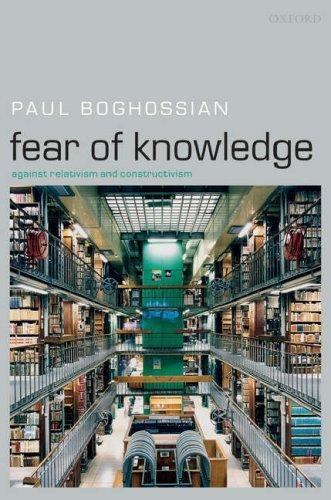
HomeFear of Knowledge by Paul Boghossian - Against Relativism and Constructivism 2007 Edition
Fear of Knowledge by Paul Boghossian - Against Relativism and Constructivism 2007 Edition
$
3.82
Topic:Epistemology, GeneralItem Length:8.5 inIntended Audience:TradeBook Title:Fear of Knowledge : Against Relativism and ConstructivismLanguage:EnglishISBN-13:9780199230419gtin13:9780199230419LC Classification Number:BD181.3Item Weight:8.8 OzDewey Decimal:121Table Of Content:1. Introduction2. The Social Construction of Knowledge3. Constructing the Facts4. Relativizing the Facts5. Epistemic Relativism Defended6. Epistemic Relativism Rejected7. The Paradox Resolved8. Epistemic Reasons and the Explanation of BeliefEpilogueItem Height:0.4 inSynopsis:The idea that science is just one more way of knowing the world and that there are other, radically different, yet equally valid ways, has taken deep root in academia. In Fear of Knowledge, Paul Boghossian tears these relativist theories of knowledge to shreds. He argues forcefully for the intuitive, common-sense view--that the world exists independent of human opinion and that there is a way to arrive at beliefs about the world that are objectively reasonable to anyone capable of appreciating the relevant evidence, regardless of their social or cultural perspective. This short, lucid, witty book shows that philosophy provides rock-solid support for common sense against the relativists; it is provocative reading throughout the discipline and beyond., Relativist and constructivist conceptions of truth and knowledge have become orthodoxy in vast stretches of the academic world in recent times. In his long-awaited first book, Paul Boghossian critically examines such views and exposes their fundamental flaws. This short, lucid, witty book shows that philosophy provides rock-solid support for common sense against the relativists; it will prove provocative reading throughout the discipline and beyond.'This is a book that can be read in an afternoon and thought about for a lifetime.'William Ewald, Wall Street Journal, The academic world has been plagued in recent years by scepticism about truth and knowledge. Paul Boghossian, in his long-awaited first book, sweeps away relativist claims that there is no such thing as objective truth or knowledge, but only truth or knowledge from a particular perspective. He demonstrates clearly that such claims don't even make sense. Boghossian focuses on three different ways of reading the claim that knowledge is socially constructed - one as a thesis about truth and two about justification. And he rejects all three. The intuitive, common-sense view is that there is a way things are that is independent of human opinion, and that we are capable of arriving at belief about how things are that is objectively reasonable, binding on anyone capable of appreciating the relevant evidence regardless of their social or cultural perspective. Difficult as these notions may be, it is a mistake to think that recent philosophy has uncovered powerful reasons for rejecting them. This short, lucid, witty book shows that philosophy provides rock-solid support for common sense against the relativists; it will prove provocative reading throughout the discipline and beyond.Format:PerfectItem Width:5.4 inGenre:PhilosophyDewey Edition:22brand:Oxford University Press, IncorporatedReviews:...the book does a fine job of assessing in brief compass the sort of relativism/constructivism advocated by Rorty and his fellow travelers, and Boghossian's sophisticated and careful arguments against that Rortian view are often ingenious and invariably telling., 'The idea that knowledge is socially constructed has become a commonplace in some fields of academic thought. In this short and splendid book, Boghossian (New York Univ.) makes this idea the subject of both sympathetic examination and devastating criticism. . . . For all its sophistication anderudition, the writing is remarkably clear, free of specialized jargon, and accessible to nonspecialist readers. In both subject matter and execution, this book promises to become a small classic of philosophical analysis.'Choice, 'Review from previous edition lucid and effective ... For those prepared to follow its careful and sensible arguments, Fear of Knowledge should be a welcome addition to the literature.'Simon Blackburn, Times Literary Supplement, "This is a book that can be read in an afternoon and thought about for a lifetime. His analysis is something of a tour de force: subtle and original enough to attract the attention of professional philosophers but accessible enough to be read by anyone with an interest in the subject. The result is one of the most readable works in philosophy in recent years."--Wall Street Journal"The book does a fine job of assessing in brief compass the sort of relativism/constructivism advocated by Rorty and his fellow travelers, and Boghossian's sophisticated and careful arguments against that Rortian view are often ingenious and invariably telling. Aimed at non-specialists, Fear of Knowledge may well succeed in distancing those who are enamored of 'postmodern relativism'. . . from their postmodern enthusiasms."--Harvey Siegel, Notre Dame Philosophical Reviews"Boghossian has written an excellent book.... it contains relentless exposures of confusion, falsehood, and incoherence."--John R. Searle, New York Review of Books, 'the book does a fine job of assessing in brief compass the sort of relativism/constructivism advocated by Rorty and his fellow travelers, and Boghossian's sophisticated and careful arguments against that Rortian view are often ingenious and invariably telling. Aimed at non-specialists, iFearof Knowledge/i may well succeed in distancing those who are enamored of "postmodern relativism" . . . from their postmodern enthusiasms.'Harvey Siegel, Notre Dame Philosophical Reviews, If only Boghossian's eminently reasonable book were required reading for every freshman considering entrance into the humanities..., Boghossian has written an excellent book ... it contains relentless exposures of confusion, falsehood, and incoherence., If only Boghossian's eminently reasonable book were required reading for every freshman considering entrance into the humanities-the next generation of lay-people would be saved from the uncomprehending repetition of relativist slogans, and future scholars would be kept from mounting baroque, ineffectual attempts at their defense. Fear of Knowledge is engaging, easy to read, and hard to dispute. It's a satisfying work for those in the choir who will enjoy seeing written on the pageprecisely what we would say to constructivists were we endowed with Boghossian's rhetorical elegance., lucid and effective ... For those prepared to follow its careful and sensible arguments, Fear of Knowledge should be a welcome addition to the literature., This is a great book for a seminar or discussion group. And its about time that someone wrote it. Happily, it was someone with Boghossians clarity, verve, and panache., In both subject matter and execution, this book promises to become a small classic of philosophical analysis., ...a tour de force: subtle and original enough to attract the attention of professional philosophers but accessible enough to be read by anyone with an interest in the subject. The result is one of the most readable works of philosophy in recent years. . . . He shows the depth of the underlying philosophical ideas and, at the same time, shows that it is possible to write about them clearly, persuasively and without hysteria. This is a book that can be read in an afternoon andthought about for a lifetime., For all its sophistication and erudition, the writing is remarkably clear, free of specialized jargon, and accessible to nonspecialist readers., The idea that knowledge is socially constructed has become a commonplace in some fields of academic thought. In this short and splendid book, Boghossian (New York Univ.) makes this idea the subject of both sympathetic examination and devastating criticism. . . . For all its sophistication and erudition, the writing is remarkably clear, free of specialized jargon, and accessible to nonspecialist readers. In both subject matter and execution, this book promises to become a smallclassic of philosophical analysis., ...a tour de force: subtle and originalbut accessible enough to be read by anyone with an interest in the subject., "This is a book that can be read in an afternoon and thought about for a lifetime. His analysis is something of a tour de force: subtle and original enough to attract the attention of professional philosophers but accessible enough to be read by anyone with an interest in the subject. The result is one of the most readable works in philosophy in recent years."--Wall Street Journal "The book does a fine job of assessing in brief compass the sort of relativism/constructivism advocated by Rorty and his fellow travelers, and Boghossian's sophisticated and careful arguments against that Rortian view are often ingenious and invariably telling. Aimed at non-specialists,Fear ofKnowledgemay well succeed in distancing those who are enamored of 'postmodern relativism'. . . from their postmodern enthusiasms."--Harvey Siegel,Notre Dame Philosophical Reviews "Boghossian has written an excellent book.... it contains relentless exposures of confusion, falsehood, and incoherence."--John R. Searle,New York Review of Books, "This is a book that can be read in an afternoon and thought about for a lifetime. His analysis is something of a tour de force: subtle and original enough to attract the attention of professional philosophers but accessible enough to be read by anyone with an interest in the subject. The result is one of the most readable works in philosophy in recent years."--Wall Street Journal "The book does a fine job of assessing in brief compass the sort of relativism/constructivism advocated by Rorty and his fellow travelers, and Boghossian's sophisticated and careful arguments against that Rortian view are often ingenious and invariably telling. Aimed at non-specialists, Fear of Knowledge may well succeed in distancing those who are enamored of 'postmodern relativism'. . . from their postmodern enthusiasms."--Harvey Siegel, Notre Dame Philosophical Reviews "Boghossian has written an excellent book.... it contains relentless exposures of confusion, falsehood, and incoherence."--John R. Searle, New York Review of Books, 'This is a serious intellectual matter. Thinkers as eminent as Hume, Kant, Nietzsche, Hegel, and William James, while conceding objectivist truths, have embraced some form of relativism about some aspects of human knowledge. In his marvelous "Fear of Knowledge," Paul Boghossian, a professor ofphilosophy at New York University, gives a remarkably clear introduction to the entire debate, and in scarcely more than 100 pages. . . . His analysis is something of a tour de force: subtle and original enough to attract the attention of professional philosophers but accessible enough to be read byanyone with an interest in the subject. The result is one of the most readable works of philosophy in recent years. . . . He shows the depth of the underlying philosophical ideas and, at the same time, shows that it is possible to write about them clearly, persuasively and without hysteria. This isa book that can be read in an afternoon and thought about for a lifetime.'William Ewald, Wall Street, "This is a book that can be read in an afternoon and thought about for a lifetime. His analysis is something of a tour de force: subtle and original enough to attract the attention of professional philosophers but accessible enough to be read by anyone with an interest in the subject. The result is one of the most readable works in philosophy in recent years."-- Wall Street Journal "The book does a fine job of assessing in brief compass the sort of relativism/constructivism advocated by Rorty and his fellow travelers, and Boghossian's sophisticated and careful arguments against that Rortian view are often ingenious and invariably telling. Aimed at non-specialists, Fear of Knowledge may well succeed in distancing those who are enamored of 'postmodern relativism'. . . from their postmodern enthusiasms."--Harvey Siegel, Notre Dame Philosophical Reviews "Boghossian has written an excellent book.... it contains relentless exposures of confusion, falsehood, and incoherence."--John R. Searle, New York Review of BooksPublication Year:2007Publisher:Oxford University Press, IncorporatedNumber of Pages:148 PagesAuthor:Paul BoghossianISBN-10:0199230412
The seller has not provided a description for this item. Contact them with any questions before purchasing.
Rated 3 out of 5
A thought-provoking read that challenges relativism and constructivism with clear, compelling arguments. Boghossian presents a strong case for objective knowledge, making it a must-read for anyone interested in philosophy or epistemology. The book arrived in perfect condition—highly recommend!