

Haynes Apollo 11 1969 Nasa First Moon Landing Hb Technical Photo History Hardbou
$ 15.69
Description
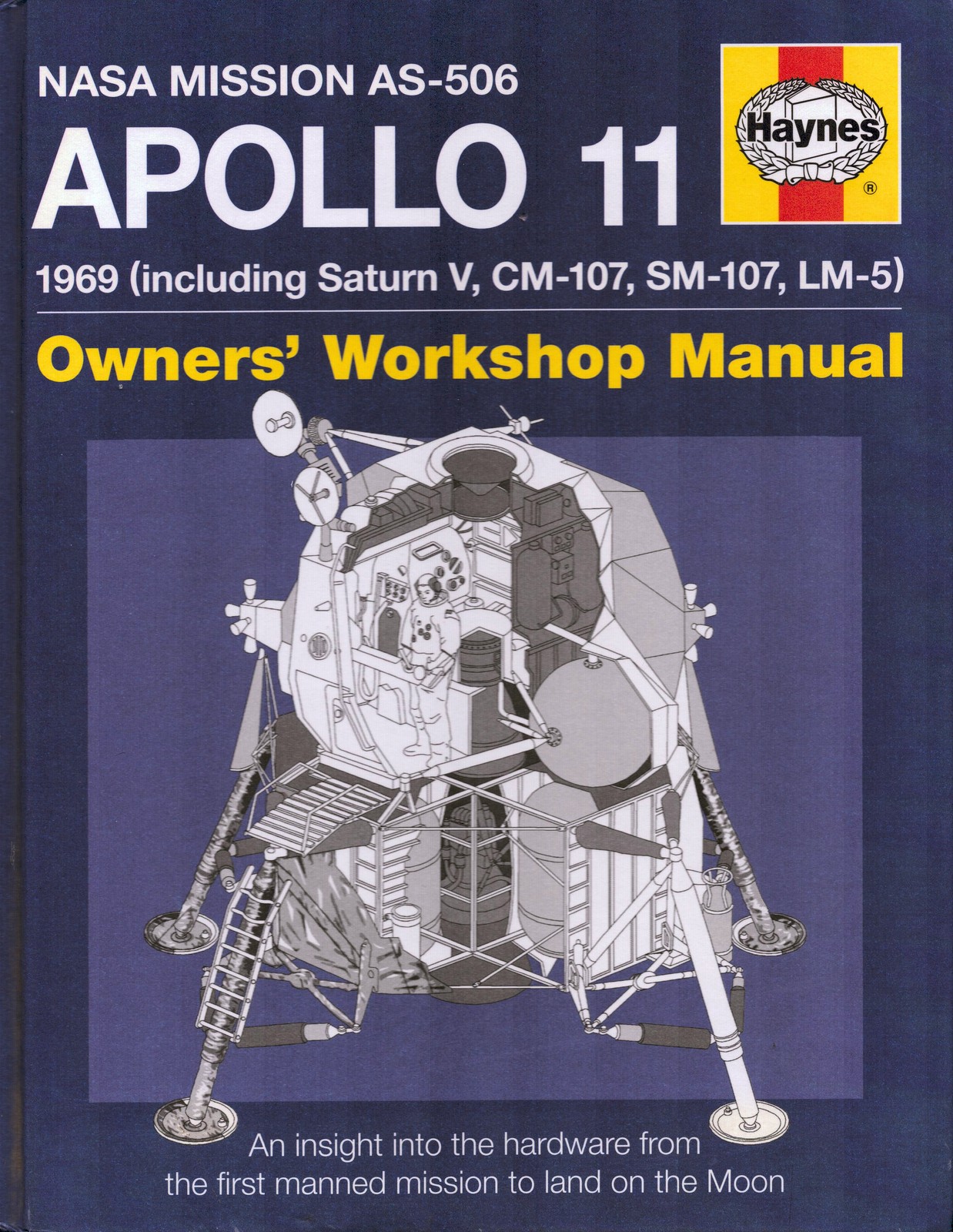
HAYNES APOLLO 11 1969 NASA FIRST MOON LANDING HB TECHNICAL PHOTO HISTORY HARDBOU. The Apollo command and service module (CSM) was one of two principal components of the United States Apollo spacecraft, used for the Apollo program, which landed astronauts on the Moon between 1969 and 1972. HAYNES APOLLO 11 1969 NASA FIRST MOON LANDING HB TECHNICAL PHOTO HISTORY HARDBOU HAYNES APOLLO 11 1969 NASA FIRST MOON LANDING HB TECHNICAL PHOTO HISTORY HARDBOUND BOOK in ENGLISH by CHRISTOPHER RILEY and PHIL DOLLING NASA MISSION AS-506 INTRODUCTION (THE DREAM OF SPACE TRAVEL, WW2 ROCKET RESEARCH, THE COLD WAR, THE SPACE RACE BEGINS, DAWN OF APOLLO, THE FIRST MAN INTO SPACE, PRESIDENT JOHN F. KENNEDY, HOW COULD IT BE DONE?, PRIME CREW, BACKUP CREW, FLIGHT DIRECTORS) THE SATURN V ROCKET (SATURN 1, SATURN 1B, SATURN V, APOLLO 4) THE COMMAND AND SERVICE MODULES (A NEW KIND OF SPACECRAFT, ELECTRICAL POWER, LIFE-SUPPORT SYSTEMS, CHANGES AFTER THE APOLLO 1 FIRE, TEMPERATURE REGULATION, FOOD, TOILET, PERSONAL HYGIENE, TO THE MOON) GUIDANCE, NAVIGATION AND CONTROL SYSTEM (INTEGRATED GUIDANCE SYSTEM, INERTIAL MEASUREMENT UNIT, SEXTANT, COMPUTER, THE LANDING AND ALARMS) THE LUNAR MODULE (WEIGHT CONCERNS, DESCENT STAGE, ASCENT STAGE, CREW COMPARTMENT, HOW TO LAND ON THE MOON, HOW TO TAKEOFF FROM THE MOON) THE SPACE SUITS (WATER COOLING SYSTEM, PRESSURIZED INNER SUIT, OUTER PROTECTIVE SUIT, HELMET AND VISOR ASSEMBLY, GLOVES AND BOOTS, LIFE-SUPPORT BACKPACK, WASTE MANAGEMENT, FOOD AND DRINK, “ONE SMALL STEP…’ COMMUNICATIONS SYSTEM (TALKING ACROSS SPACE, MISSION CONTROL, APOLLO BEEPS, TV FROM THE MOON, FILMING APOLLO) BEYOND APOLLO 11 (THE MASTER PLAN, MISCONCEPTIONS AND CONSPIRACY THEORIES, WHY DID WE STOP GOING TO THE MOON) APOLLO ACRONYMS AND ABBREVIATIONS MISSION LIST FIELD GUIDE TO APOLLO HARDWARE -------------------------------- Additional Information from Internet Encyclopedia The Apollo command and service module (CSM) was one of two principal components of the United States Apollo spacecraft, used for the Apollo program, which landed astronauts on the Moon between 1969 and 1972. The CSM functioned as a mother ship, which carried a crew of three astronauts and the second Apollo spacecraft, the Apollo Lunar Module, to lunar orbit, and brought the astronauts back to Earth. It consisted of two parts: the conical command module, a cabin that housed the crew and carried equipment needed for atmospheric reentry and splashdown; and the cylindrical service module which provided propulsion, electrical power and storage for various consumables required during a mission. An umbilical connection transferred power and consumables between the two modules. Just before reentry of the command module on the return home, the umbilical connection was severed and the service module was cast off and allowed to burn up in the atmosphere. The CSM was developed and built for NASA by North American Aviation starting in November 1961. It was initially designed to land on the Moon atop a landing rocket stage and return all three astronauts on a direct-ascent mission, which would not use a separate lunar module, and thus had no provisions for docking with another spacecraft. This, plus other required design changes, led to the decision to design two versions of the CSM: Block I was to be used for uncrewed missions and a single crewed Earth orbit flight (Apollo 1), while the more advanced Block II was designed for use with the lunar module. The Apollo 1 flight was cancelled after a cabin fire killed the crew and destroyed their command module during a launch rehearsal test. Corrections of the problems which caused the fire were applied to the Block II spacecraft, which was used for all crewed spaceflights Nineteen CSMs were launched into space. Of these, nine flew humans to the Moon between 1968 and 1972, and another two performed crewed test flights in low Earth orbit, all as part of the Apollo program. Before these, another four CSMs had flown as uncrewed Apollo tests, of which two were suborbital flights and another two were orbital flights. Following the conclusion of the Apollo program and during 1973–1974, three CSMs ferried astronauts to the orbital Skylab space station. Finally in 1975, the last flown CSM docked with the Soviet craft Soyuz 19 as part of the international Apollo–Soyuz Test Project. The Apollo Lunar Module, originally designated the Lunar Excursion Module (LEM), was the lunar lander spacecraft that was flown between lunar orbit and the Moon's surface during the United States' Apollo program. It was the first crewed spacecraft to operate exclusively in space, and remains the only crewed vehicle to land anywhere beyond Earth. Structurally and aerodynamically incapable of flight through Earth's atmosphere, the two-stage Lunar Module was ferried to lunar orbit attached to the Apollo command and service module (CSM), about twice its mass. Its crew of two flew the Lunar Module from lunar orbit to the Moon's surface. During takeoff, the spent descent stage was used as a launch pad for the ascent stage which then flew back to the command module, after which it was also discarded. Overseen by Grumman, the LM's development was plagued with problems that delayed its first uncrewed flight by about ten months and its first crewed flight by about three months. Regardless, the LM became the most reliable component of the Apollo–Saturn space vehicle. The total cost of the LM for development and the units produced was $21.65 billion in 2016 dollars, adjusting from a nominal total of $2.29 billion using the NASA New Start Inflation Indices. Ten Lunar Modules were launched into space. Of these, six were landed by humans on the Moon from 1969 to 1972. The first two flown were tests in low Earth orbit: Apollo 5, without a crew; and Apollo 9 with a crew. A third test flight in low lunar orbit was Apollo 10, a dress rehearsal for the first landing, conducted on Apollo 11. The Apollo 13 Lunar Module functioned as a lifeboat to provide life support and propulsion to keep the crew alive for the trip home, when their CSM was disabled by an oxygen tank explosion en route to the Moon. The six landed descent stages remain at their landing sites; their corresponding ascent stages crashed into the Moon following use. One ascent stage (Apollo 10's Snoopy) was discarded in a heliocentric orbit after its descent stage was discarded in lunar orbit. The other three LMs were destroyed during controlled re-entry in the Earth's atmosphere: the four stages of Apollo 5 and Apollo 9 each re-entered separately, while Apollo 13's Aquarius re-entered as a unit. The Saturn V is an American super heavy-lift launch vehicle developed by NASA under the Apollo program for human exploration of the Moon. The rocket was human-rated, had three stages, and was powered by liquid fuel. Flown from 1967 to 1973, it was used for nine crewed flights to the Moon and to launch Skylab, the first American space station. As of 2025, the Saturn V remains the only launch vehicle to have carried humans beyond low Earth orbit (LEO). The Saturn V holds the record for the largest payload capacity to low Earth orbit, 140,000 kg (310,000 lb), which included unburned propellant needed to send the Apollo command and service module and Lunar Module to the Moon. The largest production model of the Saturn family of rockets, the Saturn V was designed under the direction of Wernher von Braun at the Marshall Space Flight Center in Huntsville, Alabama; the lead contractors for construction of the rocket were Boeing, North American Aviation, Douglas Aircraft Company, and IBM. Fifteen flight-capable vehicles were built, not counting three used for ground testing. A total of thirteen missions were launched from Kennedy Space Center, nine of which carried 24 astronauts to the Moon from Apollo 8 to Apollo 17. Apollo 11 (July 16–24, 1969) was the fifth crewed flight in the United States Apollo program and the first spaceflight to land humans on the Moon. Commander Neil Armstrong and Lunar Module Pilot Edwin "Buzz" Aldrin landed the Lunar Module Eagle on July 20 at 20:17 UTC, and Armstrong became the first person to step onto the surface about six hours later, at 02:56 UTC on July 21. Aldrin joined him 19 minutes afterward, and together they spent about two and a half hours exploring the site they had named Tranquility Base upon landing. They collected 47.5 pounds (21.5 kg) of lunar material before re-entering the Lunar Module. In total, they were on the Moon’s surface for 21 hours, 36 minutes before returning to the Command Module Columbia, which remained in lunar orbit, piloted by Michael Collins. Apollo 11 was launched by a Saturn V rocket from Kennedy Space Center in Florida, on July 16 at 13:32 UTC (9:32 am EDT, local time). The Apollo spacecraft consisted of three parts: the command module (CM), which housed the three astronauts and was the only part to return to Earth; the service module (SM) providing propulsion, electrical power, oxygen, and water to the command module; and the Lunar Module (LM), which had two stages—a descent stage with a large engine and fuel tanks for landing on the Moon, and a lighter ascent stage containing a cabin for two astronauts and a small engine to return them to lunar orbit. After being sent to the Moon by the Saturn V's third stage, the astronauts separated the spacecraft and traveled for three days until they entered lunar orbit. Armstrong and Aldrin then moved into Eagle and landed in the Mare Tranquillitatis on July 20. The astronauts used Eagle's ascent stage to lift off from the lunar surface and rejoin Collins in the command module. They jettisoned Eagle before performing the maneuvers that propelled Columbia out of the last of its 30 lunar orbits onto a trajectory back to Earth. They returned to Earth and splashed down in the Pacific Ocean on July 24 at 16:35:35 UTC, after more than eight days in space. Armstrong's first step onto the lunar surface was broadcast on live television to a worldwide audience. He described it as "one small step for [a] man, one giant leap for mankind." Apollo 11 provided a U.S. victory in the Space Race against the Soviet Union, and fulfilled the national goal set in 1961 by President John F. Kennedy: "before this decade is out, of landing a man on the Moon and returning him safely to the Earth". In the late 1950s and early 1960s, the United States was engaged in the Cold War, a geopolitical rivalry with the Soviet Union. On October 4, 1957, the Soviet Union launched Sputnik 1, the first artificial satellite, surprising the world and fueling fears about Soviet technological and military capabilities. Its success demonstrated that the USSR could potentially deliver nuclear weapons over intercontinental distances, challenging American claims of military, economic, and technological superiority. This incident sparked the Sputnik crisis and ignited the Space Race, as both superpowers sought to demonstrate superiority in spaceflight. President Dwight D. Eisenhower responded to the challenge posed by Sputnik by creating the National Aeronautics and Space Administration (NASA), and initiating Project Mercury, which aimed to place a man into Earth orbit. The Soviets took the lead on April 12, 1961, when cosmonaut Yuri Gagarin became the first person in space and the first to orbit the Earth. Nearly a month later, on May 5, 1961, Alan Shepard became the first American in space; his 15-minute flight was suborbital, not a full orbit. Because the Soviet Union had launch vehicles with higher lift capacity, President John F. Kennedy, Eisenhower's successor, chose a challenge that exceeded the capabilities of the existing generation of rockets, so that both countries would be starting from an equal position. A crewed mission to the Moon would serve this purpose. After the crew of Apollo 10 named their spacecraft Charlie Brown and Snoopy, assistant manager for public affairs Julian Scheer wrote to George Low, the Manager of the Apollo Spacecraft Program Office at the MSC, to suggest the Apollo 11 crew be less flippant in naming their craft. The name Snowcone was used for the CM and Haystack was used for the LM in both internal and external communications during early mission planning. The LM was named Eagle after the motif which was featured prominently on the mission insignia. At Scheer's suggestion, the CM was named Columbia after Columbiad, the giant cannon that launched a spacecraft (also from Florida) in Jules Verne's 1865 novel From the Earth to the Moon. It also referred to Columbia, a historical name of the United States. In Collins' 1976 book, he said Columbia was in reference to Christopher Columbus. NASA's Apollo Site Selection Board announced five potential landing sites on February 8, 1968. These were the result of two years' worth of studies based on high-resolution photography of the lunar surface by the five uncrewed probes of the Lunar Orbiter program and information about surface conditions provided by the Surveyor program. The best Earth-bound telescopes could not resolve features with the resolution Project Apollo required. The landing site had to be close to the lunar equator to minimize the amount of propellant required, clear of obstacles to minimize maneuvering, and flat to simplify the task of the landing radar. Scientific value was not a consideration. The ascent stage of LM-5 Eagle arrived at the Kennedy Space Center on January 8, 1969, followed by the descent stage four days later, and CSM-107 Columbia on January 23. There were several differences between Eagle and Apollo 10's LM-4 Snoopy; Eagle had a VHF radio antenna to facilitate communication with the astronauts during their EVA on the lunar surface; a lighter ascent engine; more thermal protection on the landing gear; and a package of scientific experiments known as the Early Apollo Scientific Experiments Package (EASEP). The only change in the configuration of the command module was the removal of some insulation from the forward hatch. The CSM was mated on January 29, and moved from the Operations and Checkout Building to the Vehicle Assembly Building on April 14. The S-IVB third stage of Saturn V AS-506 had arrived on January 18, followed by the S-II second stage on February 6, S-IC first stage on February 20, and the Saturn V Instrument Unit on February 27. At 12:30 on May 20, the 5,443-tonne (5,357-long-ton; 6,000-short-ton) assembly departed the Vehicle Assembly Building atop the crawler-transporter, bound for Launch Pad 39A, part of Launch Complex 39, while Apollo 10 was still on its way to the Moon. A countdown test commenced on June 26, and concluded on July 2. The launch complex was floodlit on the night of July 15, when the crawler-transporter carried the mobile service structure back to its parking area. In the early hours of the morning, the fuel tanks of the S-II and S-IVB stages were filled with liquid hydrogen. Fueling was completed by three hours before launch. Launch operations were partly automated, with 43 programs written in the ATOLL programming language. Slayton roused the crew shortly after 04:00, and they showered, shaved, and had the traditional pre-flight breakfast of steak and eggs with Slayton and the backup crew. They then donned their space suits and began breathing pure oxygen. At 06:30, they headed out to Launch Complex 39. Haise entered Columbia about three hours and ten minutes before launch time. Along with a technician, he helped Armstrong into the left-hand couch at 06:54. Five minutes later, Collins joined him, taking up his position on the right-hand couch. Finally, Aldrin entered, taking the center couch. Haise left around two hours and ten minutes before launch. The closeout crew sealed the hatch, and the cabin was purged and pressurized. The closeout crew then left the launch complex about an hour before launch time. The countdown became automated at three minutes and twenty seconds before launch time. Over 450 personnel were at the consoles in the firing room. An estimated one million spectators watched the launch of Apollo 11 from the highways and beaches in the vicinity of the launch site. Dignitaries included the Chief of Staff of the United States Army, General William Westmoreland, four cabinet members, 19 state governors, 40 mayors, 60 ambassadors and 200 congressmen. Vice President Spiro Agnew viewed the launch with former president Lyndon B. Johnson and his wife Lady Bird Johnson. Around 3,500 media representatives were present. About two-thirds were from the United States; the rest came from 55 other countries. The launch was televised live in 33 countries, with an estimated 25 million viewers in the United States alone. Millions more around the world listened to radio broadcasts. President Richard Nixon viewed the launch from his office in the White House with his NASA liaison officer, Apollo astronaut Frank Borman. Lodging near Cape Canaveral was reported as being booked months ahead in advance for the launch by a Florida newspaper. Saturn V AS-506 launched Apollo 11 on July 16, 1969, at 13:32:00 UTC (9:32:00 EDT). At 13.2 seconds into the flight, the launch vehicle began to roll into its flight azimuth of 72.058°. Full shutdown of the first-stage engines occurred about 2 minutes and 42 seconds into the mission, followed by separation of the S-IC and ignition of the S-II engines. The second stage engines then cut off and separated at about 9 minutes and 8 seconds, allowing the first ignition of the S-IVB engine a few seconds later. Apollo 11 entered a near-circular Earth orbit at an altitude of 100.4 nautical miles (185.9 km) by 98.9 nautical miles (183.2 km), twelve minutes into its flight. After one and a half orbits, a second ignition of the S-IVB engine pushed the spacecraft onto its trajectory toward the Moon with the trans-lunar injection (TLI) burn at 16:22:13 UTC. On July 19 at 17:21:50 UTC, Apollo 11 passed behind the Moon and fired its service propulsion engine to enter lunar orbit. At 12:52:00 UTC on July 20, Aldrin and Armstrong entered Eagle, and began the final preparations for lunar descent. At 17:44:00 Eagle separated from Columbia. Collins, alone aboard Columbia, inspected Eagle as it pirouetted before him to ensure the craft was not damaged, and that the landing gear was correctly deployed. Eagle landed at 20:17:40 UTC on Sunday July 20 with 216 pounds (98 kg) of usable fuel remaining. Information available to the crew and mission controllers during the landing showed the LM had enough fuel for another 25 seconds of powered flight before an abort without touchdown would have become unsafe, but post-mission analysis showed that the real figure was probably closer to 50 seconds. The schedule for the mission called for the astronauts to follow the landing with a five-hour sleep period, but they chose to begin preparations for the EVA early, thinking they would be unable to sleep. Eagle's hatch was opened at 02:39:33. Armstrong initially had some difficulties squeezing through the hatch with his portable life support system (PLSS). Some of the highest heart rates recorded from Apollo astronauts occurred during LM egress and ingress. At 02:51 Armstrong began his descent to the lunar surface. The remote-control unit on his chest kept him from seeing his feet. Climbing down the nine-rung ladder, Armstrong pulled a D-ring to deploy the modular equipment stowage assembly (MESA) folded against Eagle's side and activate the TV camera. After describing the surface dust as "very fine-grained" and "almost like a powder", at 02:56:15, six and a half hours after landing, Armstrong stepped off Eagle's landing pad and declared: "That's one small step for [a] man, one giant leap for mankind." After more than 21+1⁄2 hours on the lunar surface, in addition to the scientific instruments, the astronauts left behind: an Apollo 1 mission patch in memory of astronauts Roger Chaffee, Gus Grissom, and Edward White, who died when their command module caught fire during a test in January 1967; two memorial medals of Soviet cosmonauts Vladimir Komarov and Yuri Gagarin, who died in 1967 and 1968 respectively; a memorial bag containing a gold replica of an olive branch as a traditional symbol of peace; and a silicon message disk carrying the goodwill statements by presidents Eisenhower, Kennedy, Johnson, and Nixon along with messages from leaders of 73 countries around the world. Roughly two hours later, at 17:54:00 UTC, the Apollo 11 crew on the surface safely lifted off in Eagle's ascent stage to rejoin Collins aboard Columbia in lunar orbit. Film taken from the LM ascent stage upon liftoff from the Moon reveals the American flag, planted some 25 feet (8 m) from the descent stage, whipping violently in the exhaust of the ascent stage engine. Aldrin looked up in time to witness the flag topple: "The ascent stage of the LM separated ... I was concentrating on the computers, and Neil was studying the attitude indicator, but I looked up long enough to see the flag fall over." Subsequent Apollo missions planted their flags farther from the LM. Eagle rendezvoused with Columbia at 21:24 UTC on July 21, and the two docked at 21:35. Eagle's ascent stage was jettisoned into lunar orbit at 23:41. Just before the Apollo 12 flight, it was noted that Eagle was still likely to be orbiting the Moon. Later NASA reports mentioned that Eagle's orbit had decayed, resulting in it impacting in an "uncertain location" on the lunar surface. In 2021, however, some calculations show that the lander may still be in orbit. The aircraft carrier USS Hornet, under the command of Captain Carl J. Seiberlich, was selected as the primary recovery ship (PRS) for Apollo 11 on June 5, replacing her sister ship, the LPH USS Princeton, which had recovered Apollo 10 on May 26. Hornet was then at her home port of Long Beach, California. On reaching Pearl Harbor on July 5, Hornet embarked the Sikorsky SH-3 Sea King helicopters of HS-4, a unit which specialized in recovery of Apollo spacecraft, specialized divers of UDT Detachment Apollo, a 35-man NASA recovery team, and about 120 media representatives. To make room, most of Hornet's air wing was left behind in Long Beach. Special recovery equipment was also loaded, including a boilerplate command module used for training. On July 12, with Apollo 11 still on the launch pad, Hornet departed Pearl Harbor for the recovery area in the central Pacific, in the vicinity of 10°36′N 172°24′E. A presidential party consisting of Nixon, Borman, Secretary of State William P. Rogers and National Security Advisor Henry Kissinger flew to Johnston Atoll on Air Force One, then to the command ship USS Arlington in Marine One. After a night on board, they would fly to Hornet in Marine One for a few hours of ceremonies. On arrival aboard Hornet, the party was greeted by the Commander-in-Chief, Pacific Command (CINCPAC), Admiral John S. McCain Jr., and NASA Administrator Thomas O. Paine, who flew to Hornet from Pago Pago in one of Hornet's carrier onboard delivery aircraft. FREE scheduling, supersized images and templates. Get Vendio Sales Manager. Make your listings stand out with FREE Vendio custom templates! FREE scheduling, supersized images and templates. Get Vendio Sales Manager. Over 100,000,000 served. Get FREE counters from Vendio today!