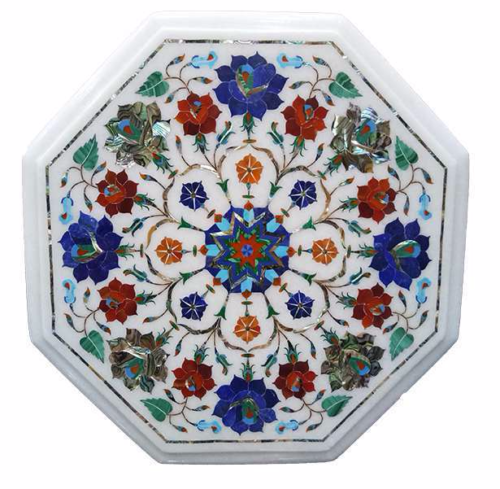
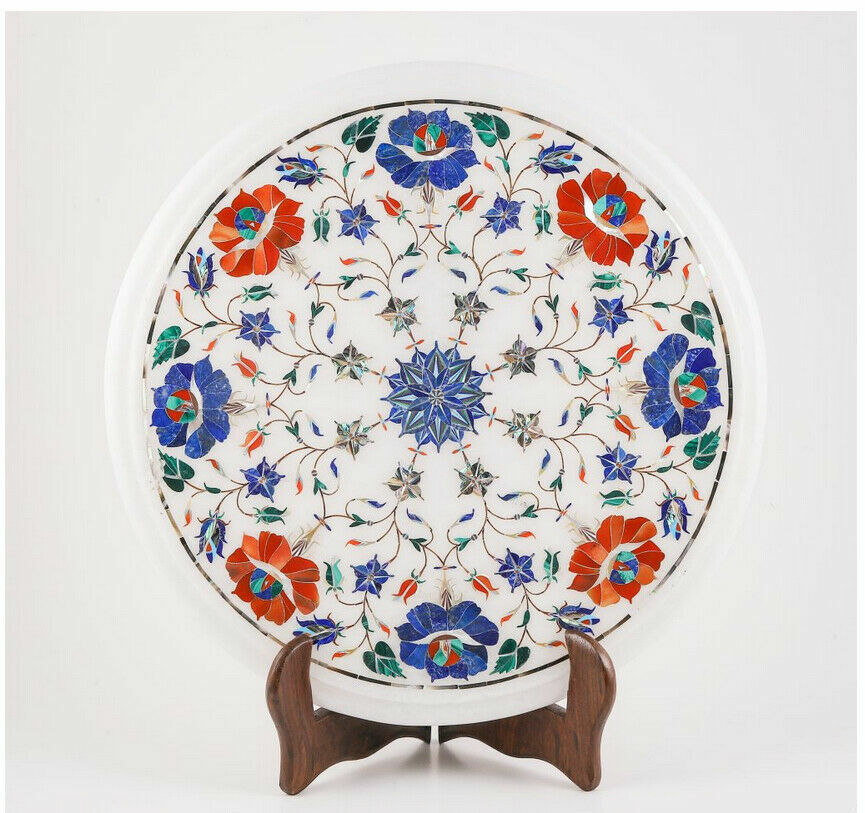
Mesa redonda de mármol de 12" incrustación floral piedras semipreciosas obra de arte
$ 131.45
Description
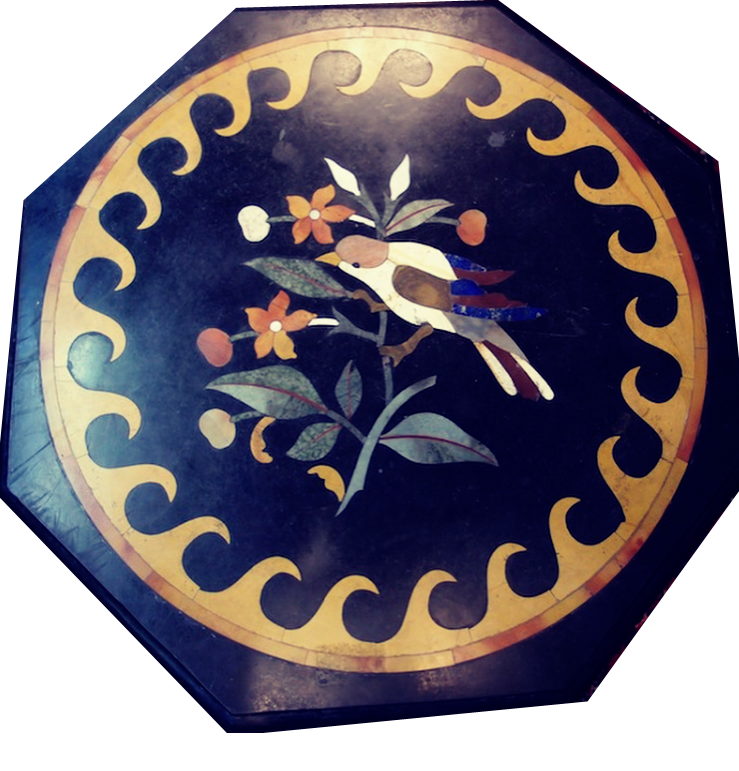
What is Inlay Art? One of the most attractive work of art that comes from marble is"Marble Inlay" work. It is the same work that adorns the Taj Mahal and other Mughal monuments. It is a closely protected traditional art and only a few expert exponents are available today. The delicate process involves cutting and engraving marble shapes manually. To start with, a predefined pattern e.g., floral design or geometrical design is engraved on the marble slab. Small pieces of marble of different shades are cut delicately to fit in these grooves precisely. These small pieces are then slipped in the grooves. Apart from marble, many other materials can also be used. History Of Inlay Art Inlay work on delicate precious stone began in the workshops of Florence in Italy around the end of the 16th century. This was known as PIETRA DURA.(Pietra= Stone, Dura= Hard) The Italians had created a classic artistic form and held a monopoly over it. From 1630 onward pietra dura appeared on movable, small objects as decorative panels, with bird and flower motifs, suitable for cabinet fronts and table tops. Some of these soon reached the Mughals in the form of presents. Of all the Mughal Emperors, Shah Jahan was the greatest patron of architecture in India. For him no amount of money or time was too much to create enduring, everlasting architectural beauty and through it be remembered always. It is in his buildings that one feels most compelled to make the connection between Mughal art and pietra dura. The Taj Mahal, the cenotaphs of the Emperor and his wife, the main floor and the surrounding marble railings bear very close resemblances to the pietra dura form. Process of Marble Inlay Art Master Craftsman carefully plans a design, which is etched lightly into the marble surface and later scored out with an iron chisel. Many of the tools of the trade are basically the same as those used by the Mughals hundreds of years ago. He then decides on the colour scheme depending on the requirements of piece being created. Semi-precious stones and gems are expertly chosen to give just the right graduation in colour and shade for the overall radiance of the pattern. They are shaped and polished by means of an emery wheel. Sometimes heat treatment is applied to certain stones to get a shading effect. The effort involved in making just one single flower can often take days of work, depending on the detail; it is not unusual to be designed from hundreds of different slices of stone. There are many varieties of coloured stone available for utilisation in marble inlay work: malachite, cornelian, jasper, mother of pearl, abalone shell, lapis lazuli, agnate, coral, turquoise and tiger eye to name just a few. The grooves are filled with their precisely corresponding shapes of coloured stone and secured in place with a white putty made from oil, and wax. Once the design is completely dry, the piece is polished with a mixture of sand, water and emery paper to give a shiny smooth finish. Note:- Customs Duty and other duties levies in destinations country are responsibility of the buyer