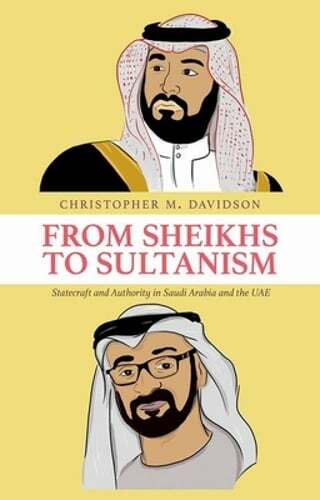
Sheikhs to Sultanism: Statecraft and Authority in Saudi Arabia and the UAE by Christopher M. Davidson 2021 Hardcover

$ 29.15

Number of Pages: 240 Pages Synopsis: Muhammad bin Salman Al-Saud and Muhammad bin Zayed Al-Nahyan, the respective princely strongmen of Saudi Arabia and the UAE, have torn up the old rules. They have spurred game-changing economic master plans, presided over vast anti-corruption crackdowns, tackled entrenched religious forces, and overseen the mass arrest of critics. In parallel, they also appear to have replaced the old 'sheikhly' consensus systems of their predecessors with something more autocratic, more personalistic, and perhaps even analytically distinct. These are the two wealthiest and most populous Gulf monarchies, and increasingly important global powers--Saudi Arabia is a G20 member, and the UAE will be the host of the World Expo in 2021-2022. Such sweeping changes to their statecraft and authority structures could well end up having a direct impact, for better or worse, on policies, economies and individual lives all around the world. Christopher M. Davidson tests the hypothesis that Saudi Arabia and the UAE are now effectively contemporary or even 'advanced' sultanates, and situates these influential states within an international model of autocratic authoritarianism. Drawing on a range of primary sources, including new interviews and surveys, From Sheikhs to Sultanism puts forward an original, empirically grounded interpretation of the rise of both MBS and MBZ., Muhammad bin Salman Al-Saud and Muhammad bin Zayed Al-Nahyan, the respective princely strongmen of Saudi Arabia and the UAE, have torn up the old rules. They have spurred game-changing economic master plans, presided over vast anti-corruption crackdowns, tackled entrenched religious forces, and overseen the mass arrest of critics. In parallel, they also appear to have replaced the old 'sheikhly' consensus systems of their predecessors with something more autocratic, more personalistic, and perhaps even analytically distinct.These are the two wealthiest and most populous Gulf monarchies, and increasingly important global powers - Saudi Arabia is a G20 member, and the UAE will be the host of the World Expo in 2021-2022. Such sweeping changes to their statecraft and authority structures could well end up having a direct impact, for better or worse, on policies, economies and individual lives all around the world.Christopher M. Davidson tests the hypothesis that Saudi Arabia and the UAE are now effectively contemporary or even 'advanced' sultanates, and situates these influential states within an international model of autocratic authoritarianism. Drawing on a range of primary sources, including new interviews and surveys, From Sheikhs to Sultanism puts forward an original, empirically grounded interpretation of the rise of both MBS and MBZ., An expert analysis of how the Saudi and Abu Dhabi crown princes, MBS and MBZ, have ushered in a new era of governance defined by personal, authoritarian rule. Table Of Content: INTRODUCTION 1 - BUILDING A REGIME-TYPE FRAMEWORK 1.1 Scholarly consensus: lessons learned 1.2 A new era: an autocratic-authoritarian turn? 1.3 Towards a hypothesis: from sheikhs to... sultanism? 2 - RESEARCH METHODS AND DATA COLLECTION 2.1 Research tasks and hypothesis-testing: a systematic study 2.2 Methodological challenges: navigating the fields of power 2.3 Methodological opportunities: circumventing the fields of power 2.4 Methodological opportunities: primary data prospects 2.5 Methodological opportunities: primary data gathering 3 - SULTANISM: STATE OF THE ART 3.1 Classical sultanism: oriental origins 3.2 Contemporary sultanism: an emerging concept 3.3 Contemporary sultanism: neo-sultanism as an ideal type 3.4 Contemporary sultanism: a Middle Eastern deficit? 3.5 Contemporary sultanism: an international empirical category 3.6 State of the art: back to the Middle East? 4 - ROUTES TO POWER: THE RISE OF MBS AND MBZ 4.1 Immediate circumstances: ambitious princes, dynastic advantages 4.2 Wider determinants: charisma and youth 4.3 Wider determinants: economic crises, fresh approaches 4.4 Wider determinants: repairing reputations 4.5 Wider determinants: mentor-mentee relations and the Trump factor 5 - ESTABLISHING CONTROL: POLITICAL PATRONAGE NETWORKS 5.1 Inner circles: close relatives 5.2 Inner circles: technocrats and gatekeepers 5.3 Heads of state: special circumstances 5.4 Outer circles: senior ruling family members 5.5 Outer circles: other ruling family members 6 - ESTABLISHING CONTROL: ECONOMIC AFFAIRS 6.1 Economic institutions: inner circle control 6.2 The UAE''s federal dimension: Abu Dhabi''s economic supremacy 6.3 Big business: anti-corruption and ''shakedowns'' 6.4 Benefits and subsidies: tentative reforms 7 - ESTABLISHING CONTROL: INSTITUTIONS, MEDIA, AND SECURITY 7.1 Institutions: executive and consultative 7.2 Institutions: justice and the courts 7.3 Legacy media: traditional controls 7.4 Social media and cyberspace: traditional controls 7.5 Social media and cyberspace: experimental counter measures 7.6 Military, security, and intelligence: changing structures 7.7 Praetorian guards: last lines of defence 8 - IDEOLOGY AND RELIGION: A BALANCING ACT 8.1 Counter ideologies: mitigating threats, supporting objectives 8.2 Islamic extremism: a harder line 8.3 Islamic extremism: external inconsistencies 8.4 Political Islam: a resurgent threat 8.5 Political Islam: external inconsistencies 8.6 State nationalism and ''liberal engineering'': rational objectives 8.7 Secular liberalism and ''tolerance'': cautious reforms 9 - ADVANCED SULTANISM: A CATEGORY EMERGES 9.1 Contemporary sultanism: aspects of convergence 9.2 Contemporary sultanism: aspects of divergence 9.3 Contemporary sultanism: explaining inconsistencies 9.4 Advanced sultanism: a category emerges 10 - ADVANCED SULTANISM: A BROADER DEBATE 10.1 Advanced sultanism: longevity and stability 10.2 Advanced sultanism: replication, promotion, and diffusion 10.3 Higher debates: from theory to philosophy APPENDIX BIBLIOGRAPHY INDEX Book Title: From Sheikhs to Sultanism : Statecraft and Authority in Saudi Arabia and the Uae Publisher: Oxford University Press, Incorporated ISBN-10: 0197586481 Reviews: "A remarkable volume from one of the most provocative and original scholars of Gulf Arab politics. Davidson fuses a sweeping and critical literature survey with detailed empirical research and fresh theoretical insights. This is a must-read for all those concerned with authoritarianism's dynamism around the globe."-- Frederic Wehrey, Senior Fellow, Middle East Program, Carnegie Endowment for International Peace "In this impressively written and meticulously detailed book, Davidson provides rich and comparative insight into the two men who, between them, have reshaped--and look set to dominate--regional politics in the Gulf for the foreseeable future."-- Kristian Coates Ulrichsen, Fellow for the Middle East, Baker Institute for Public Policy, Rice University, and author of Qatar and the Gulf Crisis "Davidson's newest book offers nuanced and theoretically refreshing insight on current political dynamics in the Gulf monarchies of Saudi Arabia and the UAE. Rich in empirical detail and engaging to read, this book will appeal to all those with an interest in contemporary Emirati and Saudi politics." -- Zahra Babar, Associate Director for Research, CIRS, Georgetown University in Qatar "With this new book, Davidson continues his tradition of posing provocative questions about Gulf politics. Examining technologies of power and political authority, he provides absorbing insight into the evolution of two of the most influential states in regional politics. A must-read."-- Simon Mabon, Professor of International Politics, Lancaster University Genre: Political Science Dewey Edition: 23 Dewey Decimal: 320.953 Author: Christopher M. Davidson gtin13: 9780197586488 Publication Year: 2021 Language: English Item Height: 1.9 in Item Weight: 27.7 Oz Topic: World / Middle Eastern ISBN-13: 9780197586488 Item Length: 8.6 in brand: Oxford University Press, Incorporated Format: Hardcover Item Width: 5.9 in

Description

  1. A fascinating deep dive into the political dynamics of Saudi Arabia and the UAE, this book offers sharp insights into authoritarian governance and state power. Davidson’s research is thorough, blending history and contemporary analysis to explain how these Gulf states maintain control. Engaging and well-written, it’s a must-read for anyone interested in Middle Eastern politics. The hardcover edition feels premium, perfect for collectors. Highly recommended!

    boclodoa450b