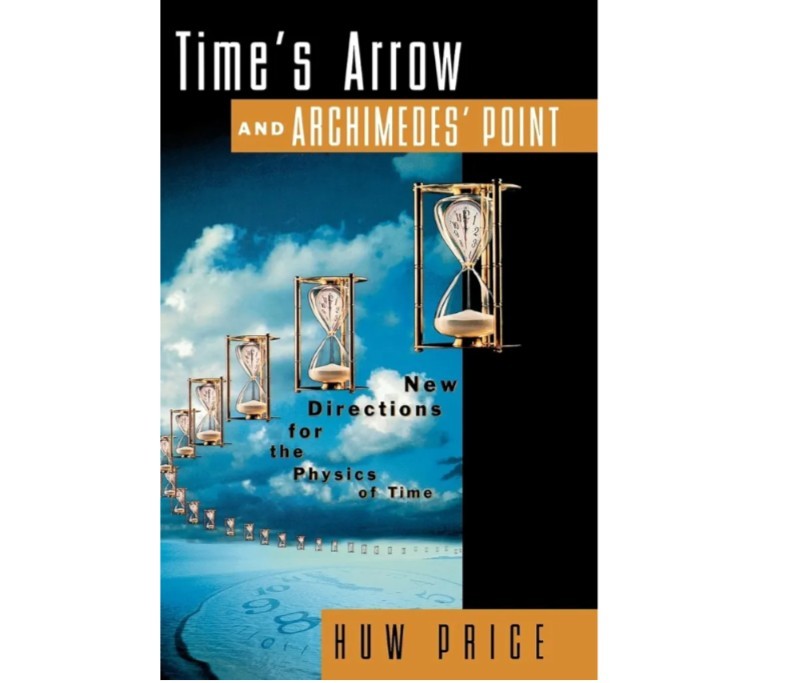
Time's Arrow and Archimedes' Point Physics of Time by Huw Price 1997 Trade Paperback

$ 3.25

Item Weight: 15.9 Oz Dewey Edition: 21 LC Classification Number: BD638.P73 1996 ISBN-13: 9780195117981 Author: Huw Price Number of Pages: 320 Pages Genre: Philosophy, Science Illustrator: Yes Features: Reprint Item Height: 0.5 in Item Width: 9 in gtin13: 9780195117981 Publication Year: 1997 Format: Trade Paperback brand: Oxford University Press, Incorporated Dewey Decimal: 523.1 Book Title: Time's Arrow and Archimedes' Point : New Directions for the Physics of Time ISBN-10: 0195117980 Reviews: "Huw Price's book, Time's Arrow and Archimedes' Point is an uncompromising study of temporal asymmetry from an atemporal point of view. The result is a sustained, careful, unfailingly lucid argument to some surprising conclusions."--Steven Savitt, British Journal for the Philosophy ofScience, "[Huw Price] has taken a subject understood by a few experts and thrown open the door to the masses....Enjoy it as a feast for the imagination."--The Sunday Times (London) "Price's book is a useful addition to the literature on time, particularly as it reveals the influence of modern science on the way a philosopher thinks."--New Scientist "Succeeds with great clarity....The author has done physicists a great service in laying out so clearly and critically the nature of the various time-asymmetry problems of physics."--Nature, "Huw Price's Time's Arrow and Archimedes' Point provides a thoughtful (and thought-provoking) analysis of the time-asymmetry problem of physics which is in many ways deeper and more illuminating than accounts to be found elsewhere."--Roger Penrose, Rouse Ball Professor of Mathematics,University of Oxford and author of Shadows of the Mind and The Emperor's New Mind, "Particularly illuminating in that Price shows how philosophers and physicists have failed to see temporal symmetries because of the influence of their own temporally asymmetric perspective.... A real advance in the interpretation of quantum mechanics. Not only philosophers of science but alsotheoretical physicists should be excited about this lovely book."--J.J.C. Smart, Emeritus Professor, Australian National University, "Huw Price's Time's Arrow and Archimedes' Point provides a thoughtful (andthought-provoking) analysis of the time-asymmetry problem of physics which is inmany ways deeper and more illuminating than accounts to be foundelsewhere."--Roger Penrose, Rouse Ball Professor of Mathematics, University ofOxford and author of Shadows of the Mind and The Emperor's New Mind, "Huw Price is one of a handful of philosophers with a thorough grasp of the notorious arrow of time problem.... In this challenging book, Price applies critical reasoning and penetrating insight to the current theories of physics and cosmology that have a bearing on this problem. Among themany ideas discussed here is the controversial claim that time's arrow would reverse in a recontracting universe."--Paul Davies, Professor of Natural Philosophy, The University of Adelaide, and author of About Time and The Physics of Time Asymmetry, the author has done physicists a great service in laying out so clearly and critically the nature of the various time-asymmetry problems of physics, "The book is a tour de force. Price addresses some of the most difficult issues in physics and philosophy, and offers highly original solutions. Yet the book is written in a style which assumes no previous knowledge, and will be accessible to any reader who is prepared to think hard."--Times Literary Supplement "Time's Arrow is...a highly original and important contribution to the philosophy and physics of time. It is path-breaking in many areas, since it covers topics rarely treated by philosophers and offers novel solutions to many problems."--British Journal for the Philosophy of Science "Price is a philosopher with a real grasp of fundamental physics. He offers an original slant on some profound issues, where our understanding has advanced little since the time of St. Augustine."--The Times "[Huw Price] has taken a subject understood by a few experts and thrown open the door to the masses....Enjoy it as a feast for the imagination."--The Sunday Times (London) "Price's book is a useful addition to the literature on time, particularly as it reveals the influence of modern science on the way a philosopher thinks."--New Scientist "Succeeds with great clarity....The author has done physicists a great service in laying out so clearly and critically the nature of the various time-asymmetry problems of physics."--Nature, "This is the best philosophical book on time that I have read. It is beautifully clear, precise but non-technical, and, once I started reading it, I couldn't put it down."--Robert Weingard, Professor of Philosophy, Rutgers, "The book is a tour de force. Price addresses some of the most difficult issues in physics and philosophy, and offers highly original solutions. Yet the book is written in a style which assumes no previous knowledge, and will be accessible to any reader who is prepared to think hard."--Times Literary Supplement"Time's Arrow is...a highly original and important contribution to the philosophy and physics of time. It is path-breaking in many areas, since it covers topics rarely treated by philosophers and offers novel solutions to many problems."--British Journal for the Philosophy of Science"Price is a philosopher with a real grasp of fundamental physics. He offers an original slant on some profound issues, where our understanding has advanced little since the time of St. Augustine."--The Times"[Huw Price] has taken a subject understood by a few experts and thrown open the door to the masses....Enjoy it as a feast for the imagination."--The Sunday Times (London)"Price's book is a useful addition to the literature on time, particularly as it reveals the influence of modern science on the way a philosopher thinks."--New Scientist"Succeeds with great clarity....The author has done physicists a great service in laying out so clearly and critically the nature of the various time-asymmetry problems of physics."--Nature"Huw Price's book, Time's Arrow and Archimedes' Point is an uncompromising study of temporal asymmetry from an atemporal point of view. The result is a sustained, careful, unfailingly lucid argument to some surprising conclusions."--Steven Savitt, British Journal for the Philosophy of Science"Huw Price, who became known as 'the philosopher who took on Stephen Hawking on the arrow of time' (Scientific American, Oct. 1989), has now formulated his own lucid account of this fundamental aspect of time and the concept of causality. He presents it in a marvelously clear and picturesque manner that allows even the layman to see the point of each part of the problem, and to understand its importance for the whole. I am convinced that this book willbecome a milestone of interdisciplinary debate in its best and fertile sense."--H. D. Zeh, author of The Physical Basis of the Direction of Time"Huw Price's Time's Arrow and Archimedes' Point provides a thoughtful (and thought-provoking) analysis of the time-asymmetry problem of physics which is in many ways deeper and more illuminating than accounts to be found elsewhere."--Roger Penrose, Rouse Ball Professor of Mathematics, University of Oxford and author of Shadows of the Mind and The Emperor's New Mind"This is the best philosophical book on time that I have read. It is beautifully clear, precise but non-technical, and, once I started reading it, I couldn't put it down."--Robert Weingard, Professor of Philosophy, Rutgers"Huw Price is one of a handful of philosophers with a thorough grasp of the notorious arrow of time problem.... In this challenging book, Price applies critical reasoning and penetrating insight to the current theories of physics and cosmology that have a bearing on this problem. Among the many ideas discussed here is the controversial claim that time's arrow would reverse in a recontracting universe."--Paul Davies, Professor of Natural Philosophy, TheUniversity of Adelaide, and author of About Time and The Physics of Time Asymmetry"Particularly illuminating in that Price shows how philosophers and physicists have failed to see temporal symmetries because of the influence of their own temporally asymmetric perspective.... A real advance in the interpretation of quantum mechanics. Not only philosophers of science but also theoretical physicists should be excited about this lovely book."--J.J.C. Smart, Emeritus Professor, Australian National University, a useful addition to the literature on time, particularly as it reveals the influence of modern science on the way a philosopher thinks, "The book is a tour de force . Price addresses some of the most difficult issues in physics and philosophy, and offers highly original solutions. Yet the book is written in a style which assumes no previous knowledge, and will be accessible to any reader who is prepared to think hard."-- Times Literary Supplement " Time's Arrow is...a highly original and important contribution to the philosophy and physics of time. It is path-breaking in many areas, since it covers topics rarely treated by philosophers and offers novel solutions to many problems."-- British Journal for the Philosophy of Science "Price is a philosopher with a real grasp of fundamental physics. He offers an original slant on some profound issues, where our understanding has advanced little since the time of St. Augustine."-- The Times "[Huw Price] has taken a subject understood by a few experts and thrown open the door to the masses....Enjoy it as a feast for the imagination."-- The Sunday Times (London) "Price's book is a useful addition to the literature on time, particularly as it reveals the influence of modern science on the way a philosopher thinks."-- New Scientist "Succeeds with great clarity....The author has done physicists a great service in laying out so clearly and critically the nature of the various time-asymmetry problems of physics."-- Nature, "This is the best philosophical book on time that I have read. It isbeautifully clear, precise but non-technical, and, once I started reading it, Icouldn't put it down."--Robert Weingard, Professor of Philosophy, Rutgers, "Huw Price, who became known as 'the philosopher who took on Stephen Hawking on the arrow of time' (Scientific American, Oct. 1989), has now formulated his own lucid account of this fundamental aspect of time and the concept of causality. He presents it in a marvelously clear and picturesquemanner that allows even the layman to see the point of each part of the problem, and to understand its importance for the whole. I am convinced that this book will become a milestone of interdisciplinary debate in its best and fertile sense."--H. D. Zeh, author of The Physical Basis of the Directionof Time, "The book is a tour de force. Price addresses some of the most difficult issues in physics and philosophy, and offers highly original solutions. Yet the book is written in a style which assumes no previous knowledge, and will be accessible to any reader who is prepared to think hard."--Times Literary Supplement"Time's Arrow is...a highly original and important contribution to the philosophy and physics of time. It is path-breaking in many areas, since it covers topics rarely treated by philosophers and offers novel solutions to many problems."--British Journal for the Philosophy of Science"Price is a philosopher with a real grasp of fundamental physics. He offers an original slant on some profound issues, where our understanding has advanced little since the time of St. Augustine."--The Times "[Huw Price] has taken a subject understood by a few experts and thrown open the door to the masses....Enjoy it as a feast for the imagination."--The Sunday Times (London)"Price's book is a useful addition to the literature on time, particularly as it reveals the influence of modern science on the way a philosopher thinks."--New Scientist"Succeeds with great clarity....The author has done physicists a great service in laying out so clearly and critically the nature of the various time-asymmetry problems of physics."--Nature, "Particularly illuminating in that Price shows how philosophers andphysicists have failed to see temporal symmetries because of the influence oftheir own temporally asymmetric perspective.... A real advance in theinterpretation of quantum mechanics. Not only philosophers of science but alsotheoretical physicists should be excited about this lovely book."--J.J.C. Smart,Emeritus Professor, Australian National University Edition Description: Reprint Topic: General, Time Language: English Publisher: Oxford University Press, Incorporated Synopsis: Why is the future so different from the past? Why does the past affect the future and not the other way around? What does quantum mechanics really tell us about the world? In this important and accessible book, Huw Price throws fascinating new light on some of the great mysteries of modern physics, and connects them in a wholly original way. Price begins with the mystery of the arrow of time. Why, for example, does disorder always increase, as required by the second law of thermodynamics? Price shows that, for over a century, most physicists have thought about these problems the wrong way. Misled by the human perspective from within time, which distorts and exaggerates the differences between past and future, they have fallen victim to what Price calls the "double standard fallacy": proposed explanations of the difference between the past and the future turn out to rely on a difference which has been slipped in at the beginning, when the physicists themselves treat the past and future in different ways. To avoid this fallacy, Price argues, we need to overcome our natural tendency to think about the past and the future differently. We need to imagine a point outside time -- an Archimedean "view from nowhen" -- from which to observe time in an unbiased way. Offering a lively criticism of many major modern physicists, including Richard Feynman and Stephen Hawking, Price shows that this fallacy remains common in physics today -- for example, when contemporary cosmologists theorize about the eventual fate of the universe. The "big bang" theory normally assumes that the beginning and end of the universe will be very different. But if we are to avoid the double standard fallacy, we need to consider time symmetrically, and take seriously the possibility that the arrow of time may reverse when the universe recollapses into a "big crunch." Price then turns to the greatest mystery of modern physics, the meaning of quantum theory. He argues that in missing the Archimedean viewpoint, modern physics has missed a radical and attractive solution to many of the apparent paradoxes of quantum physics. Many consequences of quantum theory appear counterintuitive, such as Schrodinger's Cat, whose condition seems undetermined until observed, and Bell's Theorem, which suggests a spooky "nonlocality," where events happening simultaneously in different places seem to affect each other directly. Price shows that these paradoxes can be avoided by allowing that at the quantum level the future does, indeed, affect the past. This demystifies nonlocality, and supports Einstein's unpopular intuition that quantum theory describes an objective world, existing independently of human observers: the Cat is alive or dead, even when nobody looks. So interpreted, Price argues, quantum mechanics is simply the kind of theory we ought to have expected in microphysics -- from the symmetric standpoint.Time's Arrow and Archimedes' Point presents an innovative and controversial view of time and contemporary physics. In this exciting book, Price urges physicists, philosophers, and anyone who has ever pondered the mysteries of time to look at the world from the fresh perspective of Archimedes' Point and gain a deeper understanding of ourselves, the universe around us, and our own place in time., Why is the future so different from the past? Why does the past affect the future and not the other way around? What does quantum mechanics really tell us about the world? In this important and accessible book, Huw Price throws fascinating new light these great mysteries of modern physics, and connects them in a wholly original way. Price begins with the mystery of the arrow of time. Price shows that, for over a century, most physicists have thoughtabout problems of time in the wrong way. Misled by the human perspective from within time, which distorts and exaggerates the differences between past and future, they have fallen victim to what Pricecalls the "double standard fallacy": proposed explanations of the difference between the past and the future turn out to rely on a difference which has been slipped in at the beginning, when the physicists themselves treat the past and future in different ways. To avoid this fallacy, Price argues, we need to overcome our natural tendency to think about the past and the future differently. We need to imagine a point outside time--an Archimedean "view from nowhen"--from which to observe time inan unbiased way. Time's Arrow and Archimedes'Point presents an innovative and controversial view of time and contemporary physics. In this exciting book, Price urges physicists,philosophers, and anyone who has ever pondered the mysteries of time to look at the world from the fresh perspective of Archimedes' Point and gain a deeper understanding of ourselves, the universe around us, and our own place in time., Why is the future so different from the past? Why does the past affect the future and not the other way around? What does quantum mechanics really tell us about the world? In this important and accessible book, Huw Price throws fascinating new light on some of the great mysteries of modern physics, and connects them in a wholly original way. Price begins with the mystery of the arrow of time. Why, for example, does disorder always increase, as required by the second law of thermodynamics? Price shows that, for over a century, most physicists have thought about these problems the wrong way. Misled by the human perspective from within time, which distorts and exaggerates the differences between past and future, they have fallen victim to what Price calls the "double standard fallacy" proposed explanations of the difference between the past and the future turn out to rely on a difference which has been slipped in at the beginning, when the physicists themselves treat the past and future in different ways. To avoid this fallacy, Price argues, we need to overcome our natural tendency to think about the past and the future differently. We need to imagine a point outside time -- an Archimedean "view from nowhen" -- from which to observe time in an unbiased way. Offering a lively criticism of many major modern physicists, including Richard Feynman and Stephen Hawking, Price shows that this fallacy remains common in physics today -- for example, when contemporary cosmologists theorize about the eventual fate of the universe. The "big bang" theory normally assumes that the beginning and end of the universe will be very different. But if we are to avoid the double standard fallacy, we need to consider time symmetrically, and take seriously the possibility that the arrow of time may reverse when the universe recollapses into a "big crunch." Price then turns to the greatest mystery of modern physics, the meaning of quantum theory. He argues that in missing the Archimedean viewpoint, modern physics has missed a radical and attractive solution to many of the apparent paradoxes of quantum physics. Many consequences of quantum theory appear counterintuitive, such as Schrodinger's Cat, whose condition seems undetermined until observed, and Bell's Theorem, which suggests a spooky "nonlocality," where events happening simultaneously in different places seem to affect each other directly. Price shows that these paradoxes can be avoided by allowing that at the quantum level the future does, indeed, affect the past. This demystifies nonlocality, and supports Einstein's unpopular intuition that quantum theory describes an objective world, existing independently of human observers: the Cat is alive or dead, even when nobody looks. So interpreted, Price argues, quantum mechanics is simply the kind of theory we ought to have expected in microphysics -- from the symmetric standpoint. Time's Arrow and Archimedes' Point presents an innovative and controversial view of time and contemporary physics. In this exciting book, Price urges physicists, philosophers, and anyone who has ever pondered the mysteries of time to look at the world from the fresh perspective of Archimedes' Point and gain a deeper understanding of ourselves, the universe around us, and our own place in time., Why is the future so different from the past? Why does the past affect the future and not the other way around? What does quantum mechanics really tell us about the world? In this important and accessible book, Huw Price throws fascinating new light on some of the great mysteries of modern physics, and connects them in a wholly original way. Price begins with the mystery of the arrow of time. Why, for example, does disorder always increase, as required bythe second law of thermodynamics? Price shows that, for over a century, most physicists have thought about these problems the wrong way. Misled by the human perspective from within time, whichdistorts and exaggerates the differences between past and future, they have fallen victim to what Price calls the "double standard fallacy": proposed explanations of the difference between the past and the future turn out to rely on a difference which has been slipped in at the beginning, when the physicists themselves treat the past and future in different ways. To avoid this fallacy, Price argues, we need to overcome our natural tendency to think about the past and the future differently. Weneed to imagine a point outside time -- an Archimedean "view from nowhen" -- from which to observe time in an unbiased way. Offering a lively criticism of many major modern physicists,including Richard Feynman and Stephen Hawking, Price shows that this fallacy remains common in physics today -- for example, when contemporary cosmologists theorize about the eventual fate of the universe. The "big bang" theory normally assumes that the beginning and end of the universe will be very different. But if we are to avoid the double standard fallacy, we need to consider time symmetrically, and take seriously the possibility that the arrow of time may reverse when the universerecollapses into a "big crunch." Price then turns to the greatest mystery of modern physics, the meaning of quantum theory. He argues that in missing the Archimedean viewpoint, modern physics hasmissed a radical and attractive solution to many of the apparent paradoxes of quantum physics. Many consequences of quantum theory appear counterintuitive, such as Schrodinger's Cat, whose condition seems undetermined until observed, and Bell's Theorem, which suggests a spooky "nonlocality," where events happening simultaneously in different places seem to affect each other directly. Price shows that these paradoxes can be avoided by allowing that at the quantum level the future does, indeed,affect the past. This demystifies nonlocality, and supports Einstein's unpopular intuition that quantum theory describes an objective world, existing independently of human observers: the Cat is aliveor dead, even when nobody looks. So interpreted, Price argues, quantum mechanics is simply the kind of theory we ought to have expected in microphysics -- from the symmetric standpoint. Time's Arrow and Archimedes' Point presents an innovative and controversial view of time and contemporary physics. In this exciting book, Price urges physicists, philosophers, and anyone who has ever pondered the mysteries of time to look at the world from the fresh perspective of Archimedes'Point and gain a deeper understanding of ourselves, the universe around us, and our own place in time. Intended Audience: Trade Item Length: 6 in

Description

Book

  1. Just finished reading this mind-bending book, and it completely changed how I see time! Huw Price blends physics and philosophy in a way that’s both deep and surprisingly readable. The fresh perspective on time’s direction is fascinating—it challenges conventional views without being overly technical. Perfect for anyone curious about the nature of reality or the physics behind everyday experiences. A thought-provoking gem that sticks with you long after the last page!

    tnazare3465a