
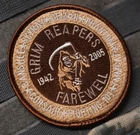
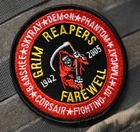
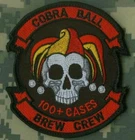
USN VF-101 GRIM REAPERS FIGHTER SQN 1942-2005 FAREWELL MEMORIAL vêlkrö INSIGNIA
$ 7.92
Description
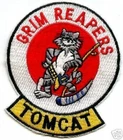
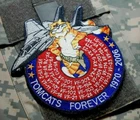
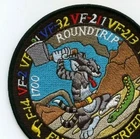
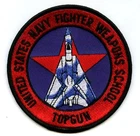
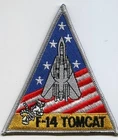
US NAVY VF-101 GRIM REAPERS FIGHTER SQN 1942-2005 FAREWELL MEMORIAL vêlkrö PATCH This is a very special US NAVY USN VF-101 GRIM REAPERS FIGHTER SQN 1942-2005 FAREWELL MEMORIAL vêlkrö PATCH. You will receive one vêlkrö Patch as shown in the first photo. You will receive the item as shown in the first photo. Please note that there are color variations due to settings on different PCs/Monitors. The color shown on your screen may not be the true color. The Grumman F-14 Tomcat is an American supersonic, twin-engine, two-seat, twin-tail, variable-sweep wing fighter aircraft. It was the first such U.S. jet fighter with twin tails. The Tomcat was developed for the United States Navy's Naval Fighter Experimental (VFX) program after the collapse of the F-111B project. The F-14 was the first of the American Teen Series fighters, which were designed incorporating air combat experience against MiG fighters during the Vietnam War. The F-14 first flew on 21 December 1970 and made its first deployment in 1974 with the U.S. Navy aboard USS Enterprise (CVN-65), replacing the McDonnell Douglas F-4 Phantom II. The F-14 served as the U.S. Navy's primary maritime air superiority fighter, fleet defense interceptor, and tactical aerial reconnaissance platform into the 2000s. The Low Altitude Navigation and Targeting Infrared for Night (LANTIRN) pod system was added in the 1990s and the Tomcat began performing precision ground-attack missions. In the 1980s, F-14s were used as land-based interceptors by the Islamic Republic of Iran Air Force during the Iran–Iraq War, where they saw combat against Iraqi warplanes. Iranian F-14s reportedly shot down at least 160 Iraqi aircraft during the war, while only 12 to 16 Tomcats were lost; at least half of these losses were due to accidents. The Tomcat was retired by U.S. Navy on 22 September 2006, having been supplanted by the Boeing F/A-18E/F Super Hornet. The F-14 remains in service with Iran's air force, having been exported to Iran in 1976. In November 2015, reports emerged of Iranian F-14s flying escort for Russian Tupolev Tu-95, Tu-160, and Tu-22M bombers on air strikes in Syria. The VF-101 Grim Reapers is the US Navy's sole Fleet Replacement Squadron for the F-14 Tomcat, training aircrew and maintenance personnel for the fleet. The squadron trains pilots, radar intercept officers, and enlisted personnel in the operation and employment of the F-14 Tomcat fighter. The squadron operates over 40 F-14A, B, and D aircraft at Naval Air Station Oceana in Virginia Beach, Virginia. In 1986, VF-101 had completed 3 years of accident free operations earning them another Safety Citation, and in March 1988 they received a third CNO Safety Award. The same year, VF-101 began to receive the F-14A+ (later redesignated F-14B), which upgraded the F-14A's underpowered and troublesome engines with new engines that improved fuel economy and added 14,600 pounds-force (65,000 newtons) of thrust over the F-14A. The new fuel economy gave the F-14B one third more time on-station and sixty percent more range. Following a year of dedicated fleet efforts, led primarily by VF-24 at NAS Miramar, California, the first-ever bomb-dropping mission conducted by fleet Tomcats occurred on August 8, 1990 (a joint VF-24/VF-211 division of aircraft). Following that, on 12 September 1990, a VF-101 Tomcat dropped bombs from a "fleet aircraft" for the first time on the east coast. Previously, although initially designed as both a fully capable fighter and strike aircraft, the Tomcat had been assigned strictly to the air-to-air role. Throughout the 1990s and early 2000s, and continuing to build on the earlier groundwork at both VX-4 and the west coast squadrons, VF-101 continued to add to its air-ground weapons training, eventually encompassing a whole range of air-to-ground weapons, from general-purpose bombs, cluster bombs, laser-guided bombs, air-launched decoys, and JDAM. VF-101's West Coast counterpart, VF-124 at NAS Miramar, was disestablished in 1994, making VF-101 the sole F-14 FRS. A VF-101 detachment was created at Miramar to continue F-14 crews and ground personnel training. When NAS Miramar became Marine Corps Air Station (MCAS) Miramar in 1996, all F-14 squadrons were moved to NAS Oceana and the VF-101 detachment was disestablished. Around this period the squadron also receive their first group of F-14D airplanes, which was the penultimate version of the Tomcat. As F-14 squadrons began to transition to the F/A-18E/F Super Hornet, VF-101's mission diminished. During this time, several VF-101 aircraft featured the markings of disestablished F-14 squadrons—among them were VF-1, VF-21, VF-24, VF-33, VF-74, VF-84, VF-111 and VF-142. As the only F-14 FRS until its disestablishment in 2005, VF-101 at one point had as many as 130 F-14s of all three variants, as well as a small number of T-34 Mentors for currency training and range safety. VF-101 was deactivated on 30 September 2005, at a ceremony at NAS Oceana. Honored guests at the ceremony were the surviving members of the Flatley family (three generations of which were VF-101 pilots), who were presented with the squadron flag. On 1 May 2012, the squadron was reactivated at Eglin Air Force Base, Florida and redesignated Strike Fighter Squadron 101 (VFA-101), The "Grim Reapers" are still an FRS; this time for the F-35C Lightning II, the aircraft carrier-capable variant of the F-35 that will serve in the U.S. Navy and selected carrier-deployable squadrons of the U.S. Marine Corps. The squadron administratively fell under Commander, Naval Air Forces and Commander Strike Fighter Wing, U.S. Pacific Fleet. In November 2014, VFA-101 passed 1,000 mishap-free flight hours in the F-35C. On 10 September 2018, the Chief of Naval Operations promulgated a notice of the "Deactivation of Strike Fighter Squadron One Zero One." . On 23 May 2019, VFA-101 completed deactivation, and was consolidated into the remaining F-35C FRS, VFA-125, the "Rough Raiders". Its assets and support personnel were moved to NAS Lemoore, home of VFA-125. The United States Navy Fighter Weapons School, commonly referred to as "Top Gun", was based at NAS Miramar, CA, but has since been moved to NAS Fallon, NV. This is the old version of their F-5 "Tiger shark" TOP GUN (STAR) patch. Top Gun is a 1986 American action drama film directed by Tony Scott, and produced by Don Simpson and Jerry Bruckheimer, in association with Paramount Pictures. The screenplay was written by Jim Cash and Jack Epps, Jr., and was inspired by an article titled "Top Guns" published in California magazine three years earlier. The film stars Tom Cruise, Kelly McGillis, Val Kilmer, Anthony Edwards, and Tom Skerritt. Cruise plays Lieutenant Pete "Maverick" Mitchell, a young Naval aviator aboard the aircraft carrier USS Enterprise. He and his Radar Intercept Officer (RIO) Nick "Goose" Bradshaw (Edwards) are given the chance to train at the Navy's Fighter Weapons School at Miramar in San Diego. In 2015, the United States Library of Congress selected the film for preservation in the National Film Registry, finding it "culturally, historically, or aesthetically significant". The Northrop F-5A and F-5B Freedom Fighter and the F-5E and F-5F Tiger II are part of a supersonic light fighter family, initially designed in the late 1950s by Northrop Corporation. Being smaller and simpler than contemporaries such as the McDonnell Douglas F-4 Phantom II, the F-5 cost less to both procure and operate, making it a popular export aircraft. The F-5 started life as a privately funded light fighter program by Northrop in the 1950s. The design team wrapped a small, highly aerodynamic fighter around two compact and high-thrust General Electric J85 engines, focusing on performance and low cost of maintenance. Though primarily designed for the day air superiority role, the aircraft is also a capable ground-attack platform. The F-5A entered service in the early 1960s. During the Cold War, over 800 were produced through 1972 for U.S. allies. Though the USAF had no acknowledged need for a light fighter, it did procure roughly 1,200 Northrop T-38 Talon trainer aircraft, which were directly based on the F-5A. After winning the International Fighter Aircraft competition in 1970, a program aimed at providing effective low-cost fighters to American allies, Northrop introduced the second-generation F-5E Tiger II in 1972. This upgrade included more powerful engines, higher fuel capacity, greater wing area and improved leading edge extensions for a better turn rate, optional air-to-air refueling, and improved avionics including air-to-air radar. Primarily used by American allies, it remains in US service to support training exercises. It has served in a wide array of roles, being able to perform both air and ground attack duties; the type was used extensively in Vietnam. A total of 1,400 Tiger IIs were built before production ended in 1987. More than 3,800 F-5 and T-38 aircraft were produced in Hawthorne, California. The F-5 was also developed into a dedicated reconnaissance version, the RF-5 Tiger eye. The F-5 also served as a starting point for a series of design studies which resulted in the Northrop YF-17 and the F/A-18navalized fighter aircraft. The Northrop F-20 Tiger shark was an advanced variant to succeed the F-5E which was ultimately canceled when export customers did not emerge. The F-5N/F variants are in service with the United States Navy and United States Marine Corps as an adversary trainer. Approximately 500 aircraft are in service as of 2014. 23 May 2019 - The last F-35C belonging to Strike Fighter Squadron (VFA) 101 “Grim Reapers” left its home base at Eglin, AFB in Fla. for Naval Air Station Lemoore (NASL) as the squadron deactivated after more than seven years of training F-35C pilots and Sailors and Marines. Grim Reaper origins can be traced back to 1942. Homeported at NAS San Diego, the squadron was originally known as VF-10 and was flying the F4F Wildcat off USS Enterprise (CV 6) in the Pacific during WWII. After the Battle of Guadalcanal, they returned to the United States and transitioned to the F6FHellcat, redeploying to the Pacific aboard Enterprise before eventually transitioning to the F4U Corsair and re-engaging in Pacific air strikes during WWII. In 1945, VF-10 deactivated at NAS Almeda. In 1952, VF-101 was commissioned at NAS Cecil Field, Fla., assuming the nickname and traditions of the previous VF-10 “Grim Reapers,” thus continuing that legacy, flying FG1-D Corsairs in the Korean War. Since then, the Grim Reaper insignia has graced the tail flash of the F2H Banshee, the F4D Skyray, the F3H Demon, the F-4 Phantom II and the F-14 Tomcat. VF-101 was deactivated September 2005. VFA-101 reactivated in May 2012, on the 60th Anniversary of the Grim Reapers, as the first Lightning II Fleet Replacement Squadron (FRS) for the F-35C. Since then, the squadron has trained more than 75 Navy and Marine Corps F-35C pilots, accepted more than 30 aircraft, trained more than 1,200 F-35C maintainers and flown nearly 11,000 flight hours. “The contributions that VFA-101 has made to the F-35C community will not diminish as this program grows,” said VFA-101 Commanding Officer Cmdr. Adan Covarrubias. “The original cadre of maintainers and pilots have left a legacy that is evidenced in all aspects of this community. Their influence will continue long after the squadron’s doors are closed.” Almost 200 people attended Thursday's ceremony as the last Grim Reaper F-35C began its journey to Naval Air Station Lemoore. Attendees included past and present Grim Reaper pilots, crew and family members. Most notably, family members of the original VF-10 Grim Reapers, the Capt. William R. Kane family and the James H. Flatley family, of which there were three generations of Grim Reaper pilots, were in attendance. The majority of F-35C pilots at VFA-101 will remain in the F-35C community, transferring to VFA-125, VFA147, VX-9 and Commander, Joint Strike Fighter Wing. Roughly, more than 50 percent of Sailor maintainers. from the Grim Reapers will also remain in the F-35C community either at Naval Air Station Lemoore with VFA-125 or VFA-147 or at VX-9 at Edwards Air Force Base. The deactivation of VFA-101 will not change or alter, in any way, the U.S. Navy Enlisted Maintenance training that is conducted at the Academic Training Center (ATC) at Eglin AFB and the Navy’s support of Test & Evaluation joint development with the U.S. Air Force, U.S. Marine Corps and the partners at Eglin Air Force Base. Naval Air Station Lemoore (NASL) is the home-base for Commander, Joint Strike Fighter Wing, the Navy’s F-35C fleet squadrons and the Fleet Replacement Squadron (FRS), VFA-125 that trains Navy and Marine Corps CVN-based JSF pilots. To accommodate the F-35C program at NAS Lemoore, several facilities were built or remodeled to facilitate specific F-35C requirements with regard to maintenance and training, including a Pilot Fit Facility, Centralized Engine Repair Facility, Pilot Training Center, and a newly-remodeled Hangar. Future projects are planned as additional Navy squadrons transition into the F-35C. Marine Corps F-35C squadrons will be based at Marine Corps Air Station Miramar, CA. “When we assessed the requirements to establish and mature the F-35C community, NAS Lemoore was the right place to home-base our Sailors and aircraft,” said U.S. Navy F-35C Wing Commodore, Capt. Max McCoy. “Consolidating resources enables leadership to better support Fleet Replacement Squadron training and operational squadron transitions, both for the Navy and Marine Corps.” McCoy also went on to explain the benefits of integrating F-35C assets with existing F/A-18E/F aircraft, currently stationed at NAS Lemoore. “Home-basing the F-35C at NAS Lemoore also gives Sailors the flexibility to move from ‘sea’ to ‘shore’ billets without leaving NAS Lemoore. The F-35C is part of the Navy’s Strike Fighter community. Co-locating 4th and 5th generation aircraft accelerates carrier air wing integration, making our carrier strike groups more lethal and survivable. NAS Lemoore is a catalyst for how we will train, maintain and sustain future carrier air wing capability.” The mission-ready F-35C is the latest addition to U.S. Navy’s Carrier Air Wing. With its stealth technology, state-of-the-art avionics, advanced sensors, weapons capacity and range, the aircraft carrier-based F-35C provides unprecedented air superiority, interdiction, suppression of enemy air defenses and close-air support as well as advanced command and control functions through fused sensors. These state-of-the art capabilities give pilots and combatant commanders unrivaled battlespace awareness and lethality . Other items in other pictures are for your reference only, available in my eBay Store. They will make a great addition to your Air Force PATCH collection. You find only US Made items here, with LIFETIME warranty. Please check out my intensive F-14 collections in my eBay Store . Personal checks are welcomed. ** eBay REQUIRES ORDER BE SENT WITH TRACKING , PLEASE SELECT USPS GROUND ADVANTAGE SERVICE w/TRACKING ** ** eBay REQUIRES ORDER BE SENT WITH TRACKING , PLEASE SELECT USPS GROUND ADVANTAGE SERVICE w/TRACKING ** We'll cover your purchase price plus shipping. FREE 30-day No-Question return ALL US-MADE PATCHES HAVE LIFETIME WARRANTY We do not compete price with cheap import copies. Watch out for cheap import copies with cut-throat price; We beat cheap copies with Original design, US-Made Quality and customer services. Once a customer, a LIFETIME of services